Jobs at Risk: Future of Work in the AI Era | Career Guide 2026
Discover which jobs are most at risk in the AI era and how to future-proof your career. Learn about automation, job trends, and high-demand skills with Career Desire's resume, LinkedIn, interview, and career guidance support.


THE HARSH REALITY BEHIND FUTURE CAREERS
A few years ago, people used to ask, "What job are you doing?"
But now, the same people are asking the same question in a completely different way:
"Will that career even survive in the future?"
And honestly, that question feels more terrifying than ever before.
Earlier, I believed getting a degree and landing a stable job was enough to secure life forever. But recently, everywhere I look, I keep hearing the same scary words:
- AI replacing jobs.
- Automation.
- Layoffs.
- Future careers.
And honestly, it made me question myself.
- What if the career we're preparing for today doesn't even exist tomorrow?
- What if the skills we spent years learning become outdated?
- What if hard work alone is no longer enough in the AI era?
And one day, while scrolling through news articles and headlines, I came across something that genuinely shocked me.
Over 1,00,000+ tech employees were laid off in 2025. Big companies like Amazon, Microsoft, Intel, Meta, and Google started cutting thousands of jobs while heavily investing in AI and automation.
Source: Times of India – "100000 Tech Layoffs in 2025: Amazon, Microsoft, Intel and These Companies Cut Thousands of Jobs" Click here
That's when fear slowly turned into curiosity.
Because this wasn't just about "their" jobs anymore.
It suddenly felt personal.
And that's when I realized something important:
The future belongs to people who learn faster than the world changes.
That's exactly why platforms like Career Desire are becoming important for students and professionals trying to stay relevant in today's competitive world.
From career guidance and ATS resume support to blogs about freelancing, AI trends, and future careers, having the right guidance today can decide where we stand tomorrow.
Want to future-proof your career? Click here for personalized guidance.Because in this generation, the biggest risk is not failure.
It's staying the same while the world keeps evolving.
So once you finish reading this blog, come back and ask yourself one question:
"Will your job still exist in the future?"
If your answer is yes, be grateful and keep upgrading yourself.
If your answer is no, don't panic.
Career Desire is here to help you move forward.Because learning, adapting, and growing are still in your hands.
AI MAY NOT REPLACE EVERY JOB — BUT IT WILL CHANGE ALMOST EVERY JOB
One of the biggest misunderstandings about AI is that people think it will suddenly erase every job overnight.
But according to reports from the World Economic Forum, the real change may happen more slowly — and more deeply.
Instead of completely replacing humans, AI is starting to reshape the way work is done.
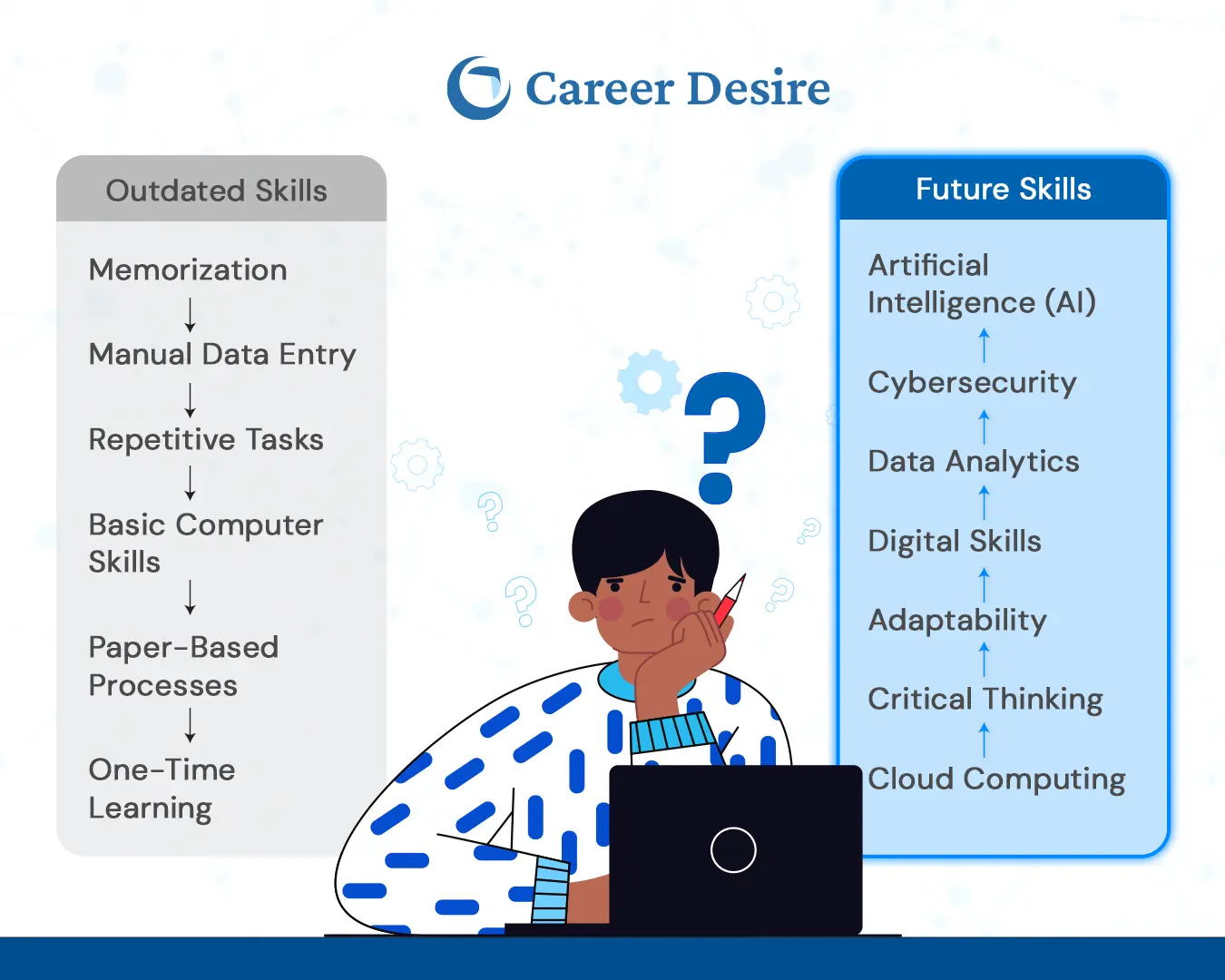
In simple words, many jobs may still exist — but the skills needed for those jobs may completely change.
That's what makes this situation both interesting and frightening at the same time.
For years, schools and colleges prepared students for a world built around offices, fixed roles, and repetitive work.
But today, companies are no longer searching only for people who can simply "follow instructions."
They are searching for people who can:
- Think creatively
- Solve problems
- Adapt quickly
- Communicate effectively
- Use AI tools productively
- Learn continuously
Because AI is not replacing entire professions.
It is replacing the repetitive and shallow version of those professions.
And maybe that's the scary part:
At some point, everyone may have to ask themselves uncomfortable questions like:
- "Am I learning skills that will still matter five years from now?"
- "Can I do something beyond what AI tools can already generate?"
- "If technology keeps evolving this fast, how do I avoid becoming outdated?"
Those questions create fear.
But they also create awareness.
Because the people who survive the AI era may not be the people with the highest degrees.
They may be the people who continuously evolve.
WHICH JOBS ARE ACTUALLY AT RISK?
The unsettling truth about AI is not that robots are suddenly taking over the world.
It's how quietly everything is changing around us.
A few years back, jobs like data entry, customer support, scheduling, repetitive office work, and basic administrative tasks were considered stable careers.
But now, many of those same tasks can be completed by AI within seconds.
According to reports discussed by Business Insider and the World Economic Forum, jobs involving repetitive and rules-based tasks are among the most vulnerable to automation.
Source: World Economic Forum & Business Insider – jobs involving repetitive and rules-based tasks are most vulnerable to automation. Click here
Even some entry-level jobs are slowly being affected:
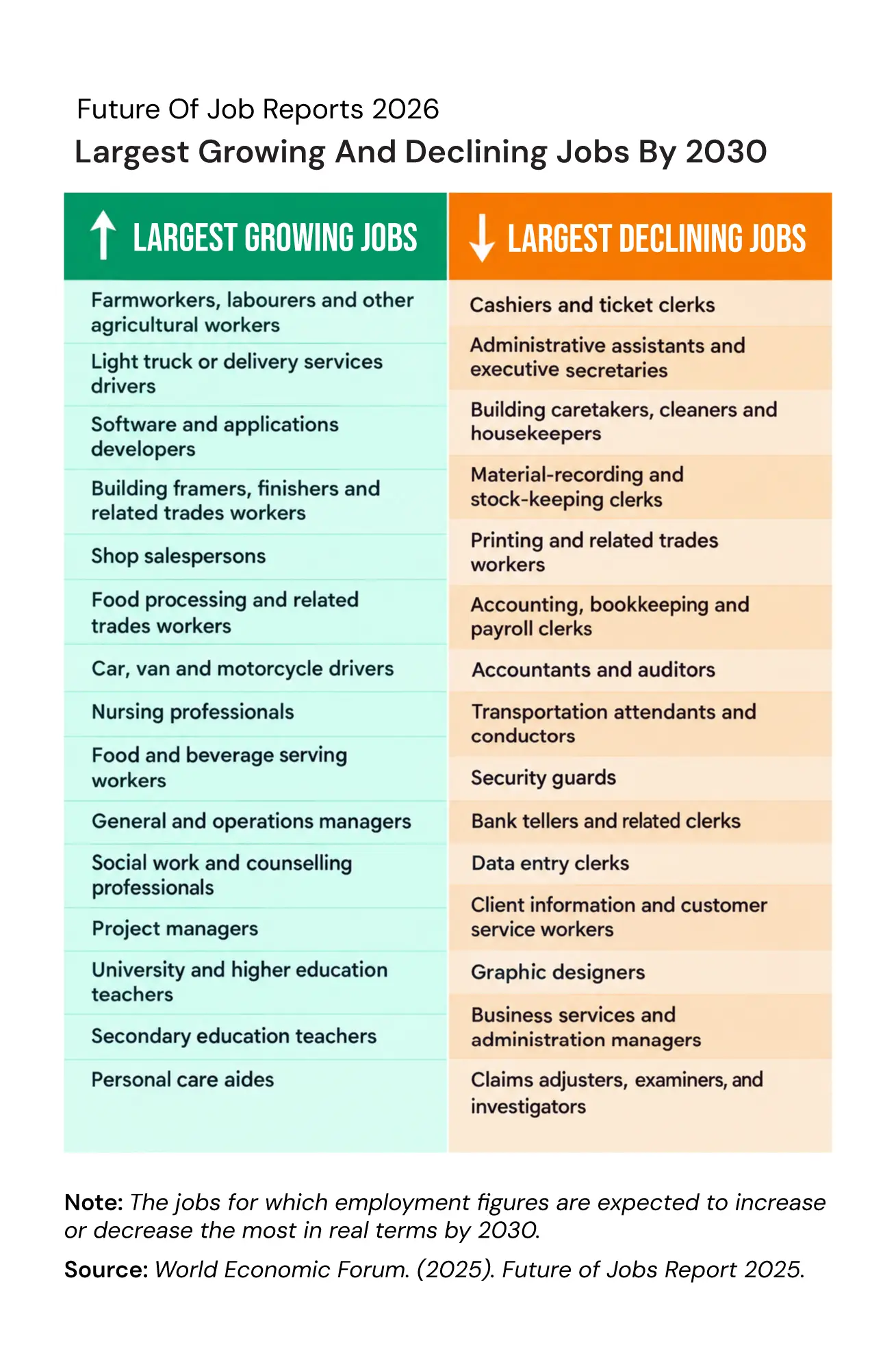
Many companies are now using AI tools to reduce the amount of human work needed for these tasks.
And that raises a question:
If AI can handle beginner-level work faster and cheaper — how will freshers gain experience in the future?
That's the part many people are afraid to talk about.
THE REAL SHIFT: HUMAN + AI
The future may not be "Human vs AI" —
It may be humans who know how to work with AI versus humans who refuse to adapt.
Today, companies are already valuing people who can combine:
- Creativity
- Communication
- Strategic thinking
- Human psychology
with AI tools and digital skills.
Because AI can generate answers.
But humans still create trust, emotions, leadership, decision-making, and original ideas.
That's why one report mentioned that nearly 39% of today's skills could become outdated by 2030, showing how important upskilling has become in the modern workplace.
Source: Business Today Report – nearly 39% of today's skills could become outdated by 2030. Click here
The future may belong to people who:
- Learn continuously
- Stay updated with technology
- Build practical skills
- Understand AI instead of fearing it
Because working hard alone is no longer enough.
Learning faster than the world changes may become the real advantage.
CAREERS THAT COULD BECOME MORE VALUABLE
While some jobs are shrinking, many new opportunities are also growing rapidly.
You can explore related career paths like:
to understand which future-ready field matches your interests and strength.
No matter how advanced technology becomes, AI still cannot fully replace human judgment and human connection.
If you want to stay relevant in the future job market, this is the best time to start exploring high-demand digital careers and future-ready skills.

SO — SHOULD WE BE SCARED?
Maybe not scared.
But definitely aware.
The people who struggle the most in the future may not be the least intelligent ones.
It may be the people who refuse to adapt.
The safest career may not belong to the person who knows everything today.
It may belong to the person who never stops learning.
And maybe that's the biggest lesson of the AI era.
Explore career guidance, skill-based blogs, ATS resume support, and future career insights on Career Desire.Related Articles
Blockchain Developer Career Guide After 12th: Skills, Jobs, Courses, Salary & Roadmap for Beginners
So, what exactly does a blockchain developer do? Think of them as the builders of a new kind of digital system one that's secure, transparent, and really hard to mess with.
AI and Machine Learning Career Path After 12th: Complete Beginner's Guide For 2025
Okay, let's be real. Artificial Intelligence (AI) and Machine Learning (ML) sound like big scary words, right? Like something only coders in hoodies at Google HQ would understand.

Digital Marketing as a Career Path After 12th: The Ultimate Beginner's Guide (2026 Edition)
Alright, picture this: You're scrolling Instagram, watching YouTube, googling random stuff and suddenly, you spot an ad that feels like it was made for you. That's not magic, that's digital marketing in action. It's basically the art (and a bit of science) of promoting brands, products, or services online whether that's through Google searches, YouTube videos, Instagram posts, snazzy websites, or even emails.